
Giving medication to a cat isn’t always easy. Even a usually affectionate cat may become restless, wriggle away or refuse to open their mouth when it’s time for treatment.
If you’ve ever struggled to give your cat a tablet or liquid medicine, you’re certainly not alone!
The good news is that a little preparation and the right technique can make the process less stressful for both of you. Whether your cat needs tablets, capsules or liquid medication, knowing how to administer it safely can help you follow their treatment plan with greater confidence.
Always follow your veterinarian’s instructions and the medication label. Give the prescribed dose at the recommended times and for the full course advised. If you’re unsure how to administer a medicine, ask your vet or veterinary nurse to demonstrate the technique before trying it at home.
Preparation Before You Give Your Cat Medication
A little preparation can make a big difference, particularly if your cat tends to wriggle or become anxious during treatment.
Before you begin:
- Check the instructions: Confirm the correct dose, timing and whether the medicine should be given with food or on an empty stomach.
- Prepare everything first: Have the medication, syringe or pill-giving device ready before handling your cat.
- Choose a comfortable spot: A quiet room and a stable, non-slip surface can help your cat feel more secure.
- Keep your movements calm and gentle: Cats can become more unsettled if they’re chased, restrained roughly or repeatedly handled.
- Consider a towel wrap: If your cat scratches or wriggles, gently wrapping their body in a towel with their head exposed may help. Stop if this causes significant distress.
- Have a reward ready: A favourite treat, gentle praise or affection can help create a more positive experience, provided treats are suitable for your cat and their medication.
If your cat becomes extremely distressed or you cannot administer the medicine safely, don’t force the process. Contact your veterinary team for advice on alternative techniques or formulations.
How to Give Tablets and Capsules to Your Cat
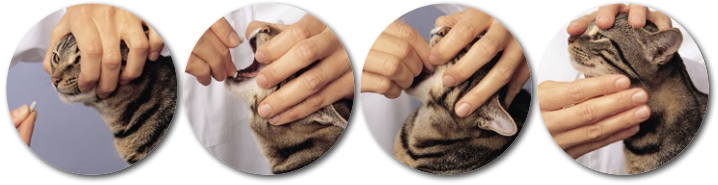
Some cats will happily take a tablet hidden in a suitable treat, while others need medication placed directly into their mouth. Always check with your vet first, as not every tablet or capsule can be crushed, opened or mixed with food.
If your vet has shown you how to give the medication directly, follow these steps.
| Step | What to do |
| 1. Prepare the tablet | Have the prescribed tablet or capsule ready. Position your cat on a stable surface or comfortably on your lap, with their body supported. |
| 2. Hold your cat’s head gently | Place your hand over the top of the head, with your thumb and fingers resting along the cheekbones. Keep your grip gentle and avoid squeezing the jaw or neck. |
| 3. Open the mouth | If you’ve been shown the correct technique, gently tilt the head upwards so the nose points towards the ceiling. The lower jaw may open slightly. Use your fingers to open the mouth carefully if needed. |
| 4. Place the medication | Place the tablet towards the back of the tongue, as demonstrated by your vet. Avoid pushing it too far back or causing your cat to gag. |
| 5. Encourage swallowing | Close the mouth gently and return the head to a natural position. A gentle stroke of the throat may encourage swallowing. Watch your cat to check that the tablet has gone down. |
| 6. Reward your cat | Offer praise and, if appropriate, a small treat or other positive reward. Follow any instructions about offering food or water after the medication. |
Important: Don’t assume your cat has swallowed the tablet just because their mouth is closed. Some cats will spit medication out once you let go, so check before moving on.
Some tablets can irritate the oesophagus if they become lodged on the way to the stomach. Ask your vet whether your cat’s medication should be followed by food or water, and how to do this safely.
How to Give Liquid Medication to Your Cat
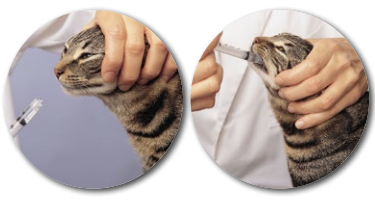
Liquid medicine can be easier to measure than tablets, but cats may dislike the taste or try to spit it out. The key is to administer it slowly and give your cat time to swallow.
| Step | What to do |
| 1. Measure the dose | Read the label and draw the prescribed amount into an oral syringe or dropper. Shake the bottle first if the instructions say to do so. |
| 2. Position your cat | Keep your cat in a comfortable, secure position. You may find it easier to have another person gently support them. |
| 3. Position the syringe | Carefully place the syringe tip into the side of the mouth, in the gap behind the canine tooth. Aim towards the inside of the cheek rather than straight down the throat. |
| 4. Give the medicine slowly | Dispense a small amount at a time, allowing your cat to swallow and breathe between each portion. Never squirt the entire dose into the back of the throat. |
| 5. Check and reward | Make sure your cat has swallowed the medication, then offer praise or a suitable reward. Clean the syringe according to your vet’s instructions. |
If your cat drools or foams at the mouth after receiving medicine, it may be reacting to an unpleasant taste. However, if your cat has difficulty breathing, repeatedly coughs or appears to choke, seek urgent veterinary attention.
If your cat spits out some of the liquid or vomits after a dose, don’t automatically give another dose. You may not know how much medication was swallowed, so contact your vet for advice.
Can You Hide Your Cat’s Medication in Food?
Sometimes, yes. Hiding medication in food or a suitable treat can be a much less stressful option, particularly for cats that strongly resist having their mouths handled.
However, check with your vet before mixing medication with food. Some medicines must be given on an empty stomach, while others should not be crushed or opened.
If your vet confirms that food is suitable, try these tips:
- Use a small amount of food your cat particularly enjoys.
- Make sure your cat eats the entire portion containing the medication.
- Watch to see whether your cat spits the tablet out.
- Avoid mixing medicine into a full bowl of food, as your cat may not finish it.
If your cat refuses the medicated food, don’t keep adding more doses to their meals. Speak with your vet about another approach.
Read More: Allergies in Cats and Dogs
Using a Pill Popper or Pilling Device
A pill popper, sometimes called a pilling device, is a small tool designed to help place a tablet towards the back of a cat’s mouth without putting your fingers as close to their teeth.
It can be useful for some cats, but it’s important to learn how to use it correctly. Ask your vet or veterinary nurse to demonstrate the technique first.
In general, the process involves:
- Placing the prescribed tablet securely at the end of the device.
- Gently positioning your cat’s head as you’ve been shown.
- Placing the tip of the device into the mouth without forcing it.
- Releasing the tablet as directed by your vet.
- Allowing your cat to swallow before offering a suitable reward.
Never force the device into your cat’s mouth or use it if your cat is struggling excessively. If you’re unsure whether a pill popper is suitable for your cat or their medication, ask your veterinary team.
What If Your Cat Won’t Take Their Medication?
Some cats are particularly difficult to medicate, even when you follow the instructions carefully. If every dose turns into a struggle, it doesn’t mean you’re doing something wrong.
Your vet may be able to suggest a different approach, such as:
- Changing from a tablet to a liquid formulation, if available.
- Using a suitable medicated treat or another food-based method.
- Demonstrating a safer and more comfortable way to administer the medicine.
- Exploring another formulation or treatment option where medically appropriate.
Don’t stop the medication, change the dose or substitute another medicine without speaking to your vet. If you miss a dose, ask what to do rather than doubling the next one.
Helping Your Cat Feel More Comfortable During Treatment
Administering medication can take patience, but keeping the experience calm and predictable may help make future doses easier.
Try to give medication in a quiet environment, handle your cat gently and reward them afterwards when appropriate. If your cat becomes increasingly fearful or aggressive, take a step back and seek advice rather than turning each dose into a stressful confrontation.
Most importantly, remember that you don’t have to figure it out alone. Your veterinary team can help you find a method that works for both you and your cat.
Need Help Giving Your Cat Medication?
At Summer Hill Village Vet, we understand that administering medication at home can be challenging, particularly when your cat refuses to cooperate. If you’re struggling with tablets, capsules or liquid medicine, our team can talk you through suitable techniques and discuss whether an alternative formulation may be available.
Contact Summer Hill Village Vet if you need help giving your cat their medication. We’re here to help you care for your feline companion with confidence.
Book an appointment or call us on 02 9797 2555.
Download our cat medication guide
Prefer to keep instructions handy? You can also download the original printable guide: