
“I have pet insurance. Won’t it cover my pet’s dental?”
We hear this surprisingly often…
The answer is:
It might—but you should never assume that it does.
Dental care is one of the areas where Australian pet insurance policies vary considerably. Some policies exclude most dental disease altogether. Others may cover certain dental illnesses or accidental tooth injuries. Some offer dental illness as an optional extra, while routine-care packages may contribute towards preventive dental services.
The important thing is to check your individual policy, ideally before your pet develops dental disease.
Does standard pet insurance usually cover a scale and polish?
Often, it does not. A routine scale and polish may be classified as preventive or routine care rather than treatment of an unexpected illness. Some insurers offer a routine-care benefit that contributes towards preventive treatments, while others provide no benefit for routine dental cleaning at all. Current Australian policy comparisons show substantial differences between insurers and levels of cover.
This means that having a comprehensive pet insurance policy does not automatically mean routine dentistry is covered. Check your Product Disclosure Statement, policy schedule or insurer directly rather than relying on the name of the policy.
Does pet insurance cover periodontal disease or tooth extractions?
Again, it depends on the policy — and on why the tooth needs treatment. Some policies offer specific dental-illness cover for conditions such as gingivitis, periodontal disease, abscesses, tooth resorption or dental disease associated with infection. Other policies specifically exclude some or all of these conditions. A traumatic fractured tooth may also be treated differently from a tooth requiring extraction because of longstanding periodontal disease.
Even where dental illness is covered, a policy may impose a separate dental benefit limit, waiting period, excess or percentage reimbursement. So the question isn’t simply “Does my pet have insurance?” — it’s: “What does my particular policy say about this particular dental condition and treatment?”
Why do some insurers require regular dental checks?
Some Australian policies require evidence of regular dental examinations or recommended dental care in order for certain dental claims to remain eligible. Current Australian policy comparisons include examples where insurers require annual dental examinations and/or treatment before dental illness benefits apply. This is one reason we recommend having your pet’s mouth assessed routinely even when everything appears normal at home.
It also highlights an important point: keep your veterinary records current. If your insurer asks when dental disease was first identified, whether treatment was previously recommended, or whether your pet has received regular dental assessments, those clinical records may become relevant to your claim.
What about a condition that existed before I bought the policy?
Pre-existing conditions are one of the most important issues to investigate. If dental disease has already been diagnosed or documented before cover starts — or before a dental benefit is added — it may be considered pre-existing and excluded from future claims. Waiting periods may also apply when dental cover is first purchased.
This is particularly relevant with dental disease because it frequently develops gradually. Buying dental cover after your veterinarian has already identified periodontal disease does not necessarily mean that treatment for that existing disease will be covered.
Does pet insurance cover feline tooth resorption?
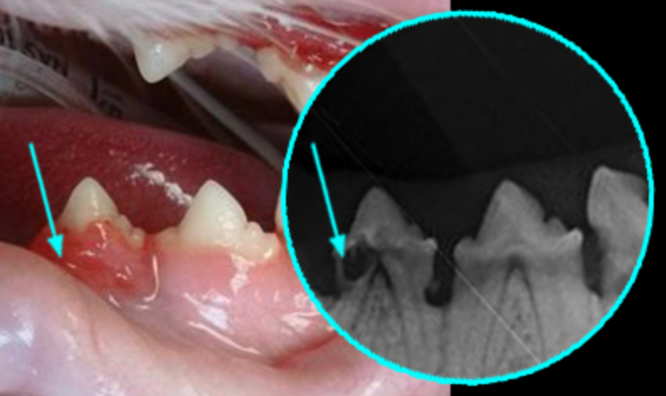
Possibly, but policies differ. Tooth resorption is a particularly important issue for cat owners — it is common, can be very painful, and may only become fully apparent during an anaesthetised dental examination and dental X-rays. Some Australian insurance products specifically include tooth resorption within dental illness benefits, while other policies exclude it or have no dental-illness cover at all.
If you own a cat and are comparing policies, this is a useful condition to ask about specifically, rather than simply asking whether the policy includes “dental”.
What should I ask my pet insurer?
Rather than asking only “Do you cover dental?”, it is worth getting more specific. Ask whether your policy covers routine dental cleaning, periodontal disease, dental X-rays, extractions, fractured teeth and feline tooth resorption. Then ask whether there is a separate dental limit, waiting period or excess, whether annual dental examinations are required, and what happens if dental disease was noted before your current cover commenced.
Ideally, obtain the answer in writing or refer to the current Product Disclosure Statement. Insurance products change, so information you were given several years ago may no longer describe your present policy.
Can Summer Hill Village Vet tell me whether my claim will be approved?
Unfortunately, no veterinarian can promise that an insurer will reimburse a particular treatment. The insurance contract is between you and your insurer, and the insurer makes the final decision about eligibility.
What Summer Hill Village Vet can do is provide the clinical history, invoices and other veterinary information required for a claim. We will ensure the medical record accurately reflects our findings and the treatment your pet received. If your insurer requires clarification of genuine clinical information, we can assist with that as well.
Should I delay dental treatment until I know whether insurance will pay?
If your pet has dental disease, the clinical question and the insurance question should ideally be considered separately. Periodontal disease is progressive — early gingivitis can advance to irreversible destruction of the tissues and bone supporting the teeth if left untreated. Dogs and cats also frequently continue eating despite dental discomfort, so waiting for obvious pain is not a reliable strategy.
If cost is a concern, tell us. Our job is to explain what we recommend, why we recommend it, and what the options are. We can then work through the practical side with you rather than allowing uncertainty about insurance to leave your pet’s dental disease unaddressed.
Insurance or not, start with knowing what’s happening in the mouth
Whether your pet’s dental treatment is insured, partially insured or not insured at all, the first step is simply understanding their dental health.
Summer Hill Village Vet provides dental care for dogs and cats across Summer Hill, Ashfield, Haberfield, Lewisham, Petersham, Dulwich Hill, Croydon, Leichhardt and Sydney’s Inner West.
Free dental checks are available until 30 September. If your pet needs a dental clean under anaesthetic, we’re also honouring last year’s dental prices for eligible procedures booked by the end of September.
A check doesn’t commit you to treatment. It gives you the information you need to make a decision.